

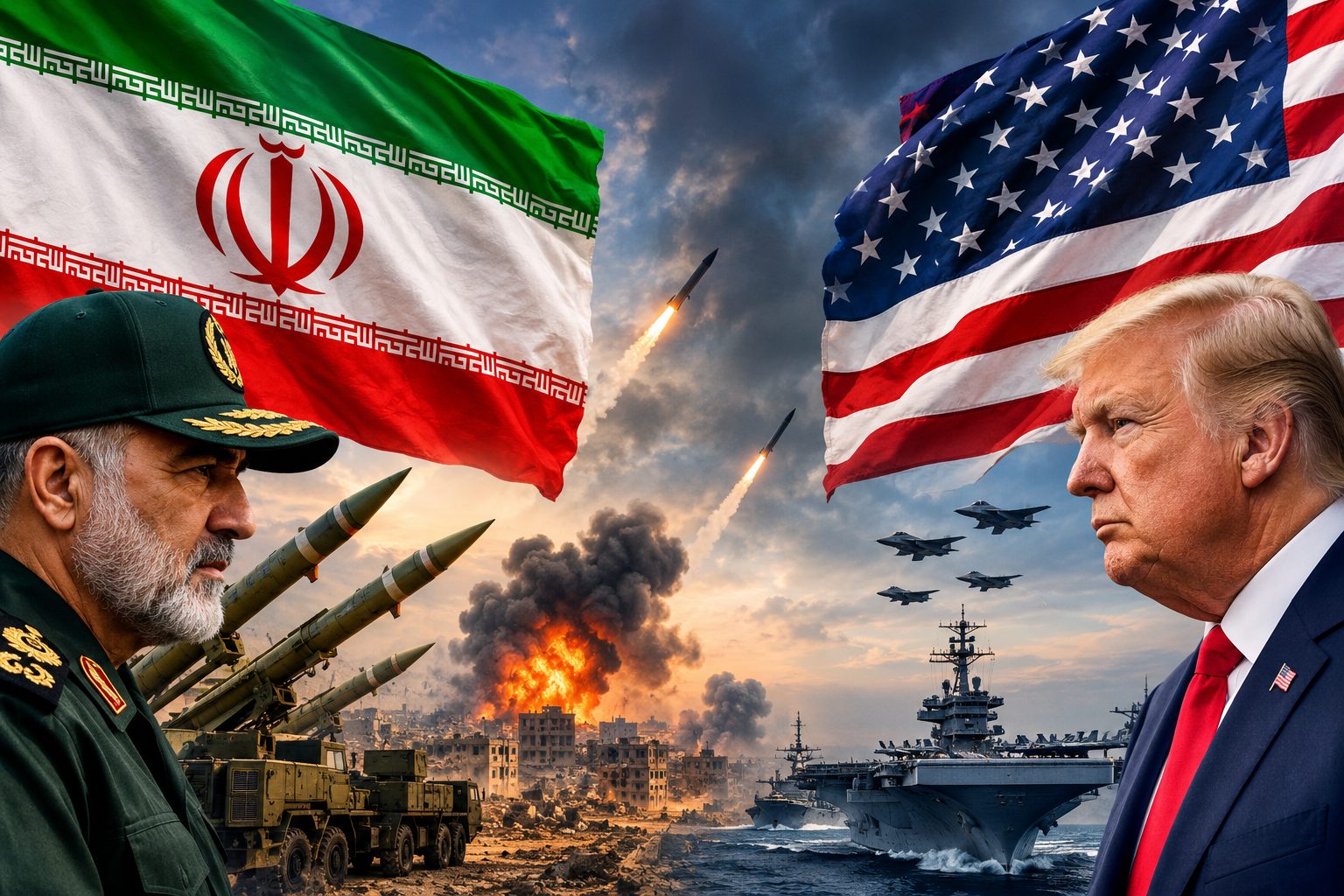
The conflict between Iran and the United States in 2026 has evolved far beyond a conventional military confrontation. What began with U.S.–Israeli strikes against Iran in February has developed into a prolonged struggle involving nuclear ambitions, regional power, economic warfare, the Strait of Hormuz, sanctions, missile attacks and competing visions of the Middle East.
As of September 7, 2026, the conflict remains unresolved. After a period of relative calm, military exchanges have intensified again, while economic pressure and diplomatic efforts continue in parallel. Recent U.S. strikes and Iranian missile and drone attacks demonstrate that neither side has found an acceptable exit strategy.
1. How did the war begin?
The roots of the conflict go back decades.
The United States and Iran have been strategic adversaries since the 1979 Iranian Revolution. Washington has viewed the Islamic Republic as a major regional challenger, while Tehran has regarded the United States as a hostile power attempting to weaken or overthrow the Iranian system.
Three issues have repeatedly brought the two countries into confrontation:
- Iran’s nuclear programme
- Iran’s ballistic-missile capabilities
- Iran’s influence through armed partners and allied groups across the Middle East
The immediate 2026 conflict began when the United States and Israel launched major strikes against Iran on February 28, 2026, targeting Iranian nuclear and military infrastructure. The campaign also resulted in the death of Supreme Leader Ayatollah Ali Khamenei.
Iran responded with attacks against Israel and U.S. military positions and interests across the region.
What followed was not a quick victory for either side, but a much longer strategic confrontation.
2. What does America actually want?
It would be simplistic to say that America is fighting Iran merely because of its nuclear programme.
The American objectives are broader.
A. Preventing a nuclear-armed Iran
The United States does not want Iran to develop a nuclear weapon because such a development could dramatically alter the balance of power in the Middle East.
Iran’s nuclear programme has therefore remained at the heart of the confrontation.
However, the situation has become more complicated because the International Atomic Energy Agency has reported that it has lost continuity of knowledge regarding parts of Iran’s nuclear programme and cannot fully account for the location of Iran’s enriched-uranium stockpile.
This creates a dangerous dilemma:
The more uncertainty there is about Iran’s nuclear capabilities, the greater the temptation for its opponents to use military force.
B. Reducing Iranian regional power
Iran has built considerable influence across the Middle East through partnerships and armed groups.
From Washington’s perspective, weakening Iran’s military infrastructure could reduce Tehran’s ability to threaten:
- Israel
- Gulf states
- U.S. military bases
- commercial shipping
- regional energy supplies
Therefore, the conflict is also a struggle over who will shape the future security architecture of the Middle East.
3. What does Iran want?
Iran’s objectives are equally important.
Tehran does not necessarily need to defeat the United States militarily.
That would be unrealistic.
Instead, Iran’s strategy is largely based on survival, deterrence and raising the cost of continued American involvement.
Iran can ask a much simpler question:
Can America sustain an expensive war indefinitely?
If the answer is no, Iran may regard endurance itself as a form of victory.
This is why Iranian attacks on U.S. assets, regional bases and shipping routes are strategically important even when they do not cause overwhelming military damage.
Iran wants to demonstrate:
“You may be stronger than us, but you cannot easily control us.”
4. The Strait of Hormuz: Iran’s most powerful economic weapon
Perhaps the most important geographical feature of the conflict is the Strait of Hormuz.
This narrow waterway connects the Persian Gulf with the Gulf of Oman and is one of the world’s most important energy corridors.
Iran’s ability to threaten shipping through the strait gives Tehran enormous strategic leverage.
The calculation is straightforward:
Iran → threatens shipping → oil supply becomes uncertain → energy prices rise → global economic pressure increases → pressure grows on Washington to negotiate.
Iran has therefore attempted to use the strait as both a military and economic bargaining tool.
However, this strategy has produced mixed results.
Recent analysis indicates that the United States has succeeded in facilitating substantial oil movement through the strait, while Iran’s attempt to use disruption to force much higher oil prices has not produced the leverage Tehran originally expected.
5. Economic warfare may become more important than missiles
This is one of the most significant developments in the conflict.
The United States possesses overwhelming conventional military superiority.
Iran knows this.
Consequently, Washington has increasingly combined military pressure with sanctions, naval pressure and restrictions on Iranian oil exports.
Reuters reported on September 6 that U.S. economic pressure was severely restricting Iranian oil exports and access to foreign currency, putting substantial pressure on Iran’s economy.
This creates a war on two fronts:
Military battlefield
Missiles, drones, aircraft, naval forces and military bases.
Economic battlefield
Oil exports, sanctions, currency, shipping and international trade.
And the second battlefield may ultimately determine the outcome.
6. Why hasn’t America simply won?
This is where the conflict becomes strategically fascinating.
America possesses vastly greater military capabilities.
But military superiority does not automatically translate into political victory.
The United States can destroy military installations.
It can damage nuclear facilities.
It can impose sanctions.
But the crucial question is:
Can it force Iran to accept America’s political objectives?
That is much harder.
Iran is a large country with a population of more than 90 million, difficult geography, substantial missile capabilities and a political system that has experience surviving international pressure.
Therefore, America faces a classic strategic problem:
Winning battles is easier than ending wars.
This is one reason analysts have warned that the conflict could become prolonged. Former U.S. Defense Secretary Leon Panetta has even warned that the war could continue for another six months and develop into a prolonged conflict resembling earlier U.S. wars in Iraq and Afghanistan.
7. Why can’t Iran simply surrender?
Because surrender could threaten the survival of the Iranian political system itself.
The conflict is not only about territory.
It is also about regime security.
Iranian leaders have to consider what happens if they make major concessions.
They could potentially face:
- internal political opposition
- military fragmentation
- economic unrest
- loss of legitimacy
- demands for further concessions
- pressure for political transformation
This makes compromise extremely difficult.
From Tehran’s perspective, giving America everything it wants could be more dangerous than continuing the conflict.
8. The nuclear dilemma
This may be the most dangerous aspect of the entire conflict.
Suppose Iran concludes:
“We were attacked because our nuclear capability made us vulnerable.”
A future Iranian leadership could potentially reach the opposite conclusion from the one Washington wants:
“We need a nuclear deterrent precisely because we were attacked.”
This creates a paradox.
The United States may attack Iran to prevent nuclear weapons.
But the experience of being attacked could strengthen arguments inside Iran for eventually acquiring a nuclear deterrent.
Strategic studies have highlighted precisely this dilemma: nuclear latency can provide deterrence, but it can also encourage adversaries to launch preventive military action.
Therefore, destroying nuclear infrastructure does not necessarily eliminate the nuclear problem.
It could potentially transform it.
9. Who is winning?
There is no simple answer.
🇺🇸 America’s advantages
- Superior air power
- Advanced intelligence and surveillance
- Powerful naval forces
- Global military logistics
- Strong economic sanctions
- Ability to strike Iranian infrastructure
- Stronger conventional military capabilities
🇮🇷 Iran’s advantages
- Large population
- Difficult geography
- Large missile and drone arsenal
- Ability to threaten regional bases
- Ability to disrupt shipping
- Domestic nationalism
- Experience surviving sanctions
- Ability to wage a long war rather than seek a quick conventional victory
Therefore, the war is not simply:
America vs. Iran
It is more accurately:
American military superiority vs. Iranian strategic endurance.
10. The biggest danger: miscalculation
The greatest danger may not be a deliberate decision to start a much larger war.
It may be an accident.
Imagine this sequence:
- Iran attacks a U.S. military facility.
- America retaliates.
- Iran interprets the retaliation as preparation for regime change.
- Iran launches a larger attack.
- America expands its targets.
- Shipping becomes increasingly dangerous.
- Israel becomes more directly involved.
- Regional armed groups enter the conflict.
- Oil infrastructure is attacked.
Suddenly, a limited confrontation becomes a regional war.
This is why the Strait of Hormuz is particularly dangerous.
Recent clashes have already involved U.S. and Iranian forces around vessels and shipping routes, while both sides have threatened further escalation.
11. What about India?
For India, this conflict is particularly important.
India has strong historical, economic and strategic relationships with countries across the Middle East.
The biggest concern is energy security.
If the conflict seriously disrupts oil and gas supplies, India could face:
- higher crude-oil prices
- higher petrol and diesel costs
- increased inflation
- pressure on the rupee
- higher transportation costs
- increased import bills
- pressure on household budgets
India also has a large diaspora in the Gulf.
Therefore, a prolonged conflict could create both an economic problem and a human-security problem.
For India, the ideal outcome is not an American victory or an Iranian victory.
It is regional stability and uninterrupted energy supplies.
12. Could the war become a world war?
Probably not in the traditional sense.
China and Russia have interests in the region, but direct participation in a major war against the United States would represent an enormous escalation.
However, the conflict can still become a global economic crisis without becoming a global military war.
Consider the chain:
Iran conflict → Hormuz disruption → oil prices rise → transportation costs rise → inflation increases → central banks respond → global economic growth slows.
That is why a conflict thousands of kilometres away can affect ordinary people around the world.
13. The diplomatic solution
Eventually, both sides will have to negotiate.
The June memorandum of understanding demonstrated that diplomacy remains possible, but the agreement failed to produce a durable settlement. The 60-day negotiating period expired in August without a final nuclear agreement.
The major issues that need to be addressed include:
Iran would probably demand:
- sanctions relief
- recognition of its sovereignty
- economic access
- security guarantees
- freedom for legitimate oil exports
America would probably demand:
- restrictions on Iran’s nuclear programme
- limits on missile capabilities
- guarantees concerning the Strait of Hormuz
- reduced support for regional armed groups
- verification mechanisms
The problem is obvious:
Both sides want security, but each side defines security differently.
14. My strategic analysis: What happens next?
I see three broad possibilities.
Scenario 1 — Negotiated settlement ⭐⭐⭐⭐
The most desirable outcome.
Economic pressure eventually becomes painful enough for Iran, while the cost of prolonged military involvement becomes uncomfortable enough for America.
Both sides compromise.
Iran gets sanctions relief and economic access.
America gets nuclear restrictions and shipping guarantees.
Neither side declares defeat.
This is probably the most realistic long-term solution.
Scenario 2 — Long stalemate ⭐⭐⭐⭐⭐
This may be the greatest immediate danger.
Neither side is willing to surrender.
Iran continues asymmetric attacks.
America continues sanctions and military pressure.
The Strait remains contested.
Diplomatic negotiations repeatedly begin and collapse.
This could create a “neither peace nor full-scale war” situation lasting months.
Recent events already show characteristics of such a stalemate.
Scenario 3 — Major regional escalation ⭐⭐
This would be the worst-case scenario.
A major attack kills large numbers of Americans or Iranians.
Israel becomes more deeply involved.
Iran expands attacks against regional U.S. interests.
Shipping becomes severely disrupted.
Other regional actors enter the conflict.
Oil prices surge.
The international community struggles to contain the escalation.
This scenario cannot be dismissed because the strategic environment remains extremely unstable.
Final Analysis: Who Can Afford to Wait Longer?
This may ultimately be the most important question.
America has the stronger military.
Iran has the stronger incentive to endure.
And wars are often decided not only by who can inflict the most damage, but by who can tolerate the costs for the longest period.
The United States can destroy Iranian military infrastructure, but destroying infrastructure is not the same as creating political stability.
Iran can survive American attacks, but survival is not the same as victory.
Therefore, the most accurate description of the current situation is:
America has greater military power; Iran possesses significant strategic resilience; neither has yet demonstrated the ability to impose a durable political settlement.
The conflict has also exposed a larger lesson about modern warfare: air superiority can win battles, economic sanctions can weaken an adversary, and missiles can impose costs—but none of these automatically creates peace.
The ultimate battlefield may therefore be neither Tehran nor Washington.
It may be the negotiating table.