

Introduction
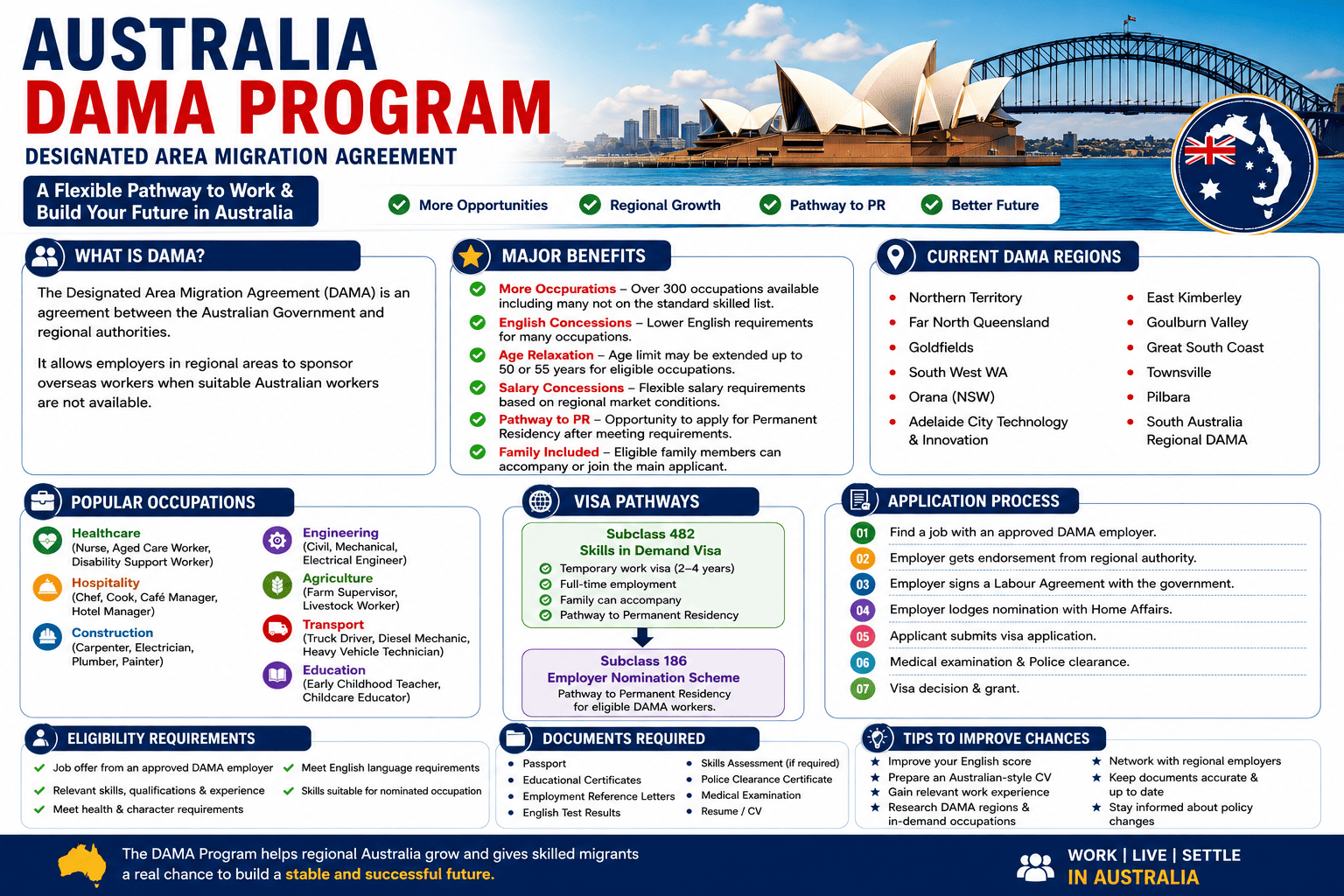
Australia has long been one of the most attractive destinations for skilled migrants due to its excellent quality of life, world-class education, strong economy, and high salaries. However, many regional areas continue to experience shortages of skilled workers. To overcome this challenge, the Australian Government introduced the Designated Area Migration Agreement (DAMA).
The DAMA Program is one of Australia’s most flexible employer-sponsored migration pathways. It enables employers in designated regional areas to recruit overseas workers when suitable Australian workers cannot be found.
Unlike standard skilled migration programs, DAMAs provide concessions on age, English language requirements, salary thresholds, and occupations, making them an attractive option for many migrants.
This article explains everything about Australia’s DAMA Program, including eligibility, benefits, occupations, visa pathways, application process, and future prospects.
What is the Australia DAMA Program?
The Designated Area Migration Agreement (DAMA) is a formal agreement between the Australian Government and a regional authority.
It allows approved employers within a designated region to sponsor overseas workers under more flexible conditions than standard employer-sponsored visas.
Instead of applying directly, workers are nominated by employers located within a DAMA region.
Why Was DAMA Introduced?
Australia faces labour shortages in many industries, particularly in regional areas.
These shortages include sectors such as:
- Healthcare
- Hospitality
- Construction
- Agriculture
- Mining
- Education
- Engineering
- Tourism
- Childcare
- Manufacturing
The DAMA program helps regional employers fill these shortages while supporting local economic growth.
Major Benefits of the DAMA Program
⭐ 1. More Occupations Available
One of the biggest advantages is the availability of occupations that are not included in standard skilled migration lists.
Many DAMA regions have over 300 approved occupations.
These include:
- Chef
- Cook
- Aged Care Worker
- Disability Support Worker
- Hotel Manager
- Carpenter
- Diesel Mechanic
- Electrician
- Welder
- Truck Driver
- Early Childhood Educator
- Nurse
- Farm Worker
- Retail Supervisor
- Café Manager
This wider occupation list significantly increases opportunities for applicants.
⭐ 2. English Language Concessions
Many DAMAs offer lower English language requirements.
Instead of the standard IELTS requirement, applicants may qualify with reduced scores depending on the occupation and region.
This particularly benefits workers in hospitality, agriculture, manufacturing, and trade occupations.
⭐ 3. Age Relaxation
Under normal employer-sponsored visas, applicants generally must be under 45 years.
Some DAMAs allow age concessions up to:
- 50 years
- 55 years (for selected occupations)
This gives experienced workers a valuable opportunity.
⭐ 4. Salary Concessions
Some regional employers cannot offer salaries meeting the standard migration threshold.
DAMA allows concessions on salary requirements while ensuring workers receive fair market wages.
⭐ 5. Pathway to Permanent Residency
Many DAMA workers become eligible for Permanent Residency after meeting residency and employment requirements.
This makes the DAMA pathway attractive for migrants planning long-term settlement in Australia.
How Does DAMA Work?
The process involves three parties:
Australian Government
Provides approval for DAMA agreements.
Regional Authority
Identifies local labour shortages and approves employer requests.
Employer
Sponsors overseas workers after demonstrating they cannot recruit suitable Australian workers.
Current DAMA Regions (2026)
Australia has several designated DAMA regions, including:
- Northern Territory
- Far North Queensland
- Goldfields
- South West Western Australia
- Orana (NSW)
- Adelaide City Technology & Innovation
- East Kimberley
- Goulburn Valley
- Great South Coast
- Townsville
- Pilbara
- South Australia Regional DAMA
Each region has its own occupation list and eligibility criteria.
Who Can Apply?
Applicants generally must:
✅ Receive a job offer from an approved DAMA employer
✅ Possess relevant qualifications or work experience
✅ Meet health requirements
✅ Meet character requirements
✅ Satisfy English language criteria
✅ Hold skills appropriate for the nominated occupation
Employer Requirements
The employer must:
- Operate within a DAMA region
- Demonstrate genuine labour shortages
- Obtain endorsement from the regional authority
- Receive approval from the Department of Home Affairs
- Nominate an overseas worker
Visa Options Under DAMA
Most workers enter Australia through:
Subclass 482 (Skills in Demand/Temporary Skilled Pathway)
Allows skilled workers to work temporarily for approved employers.
Benefits:
- Full-time employment
- Family members can accompany
- Opportunity to transition to Permanent Residency
Employer Nomination Scheme (Subclass 186)
Many DAMA workers later become eligible for Permanent Residency through employer sponsorship.
Popular Occupations
Some of the highest-demand occupations include:
Healthcare
- Registered Nurse
- Aged Care Worker
- Disability Support Worker
- Physiotherapist
Hospitality
- Chef
- Cook
- Restaurant Manager
- Café Supervisor
- Hotel Manager
Construction
- Carpenter
- Bricklayer
- Electrician
- Painter
- Plumber
Engineering
- Civil Engineer
- Mechanical Engineer
- Electrical Engineer
Agriculture
- Farm Supervisor
- Livestock Worker
- Agricultural Technician
Transport
- Truck Driver
- Diesel Mechanic
- Heavy Vehicle Technician
Education
- Early Childhood Teacher
- Childcare Educator
English Language Requirements
Requirements vary by occupation and region.
Accepted tests include:
- IELTS
- PTE Academic
- TOEFL iBT
- Cambridge English
Some occupations receive English concessions.
Age Requirements
Most skilled visas require applicants below 45 years.
However, DAMA concessions may allow:
✔ Up to 50 years
✔ Up to 55 years
depending on occupation and region.
Salary Requirements
Employers must generally pay:
- Market salary rate
- Minimum salary threshold (where applicable)
Some concessions are available under specific DAMAs.
Documents Required
Applicants generally need:
- Passport
- Educational certificates
- Employment reference letters
- English test results
- Skills assessment (if required)
- Police clearance certificate
- Medical examination
- Resume/CV
Application Process
Step 1
Find employment with an approved DAMA employer.
Step 2
Employer receives endorsement from the regional authority.
Step 3
Employer signs a Labour Agreement.
Step 4
Employer lodges nomination.
Step 5
Applicant applies for the visa.
Step 6
Medical examination and police clearance.
Step 7
Visa decision.
Advantages of the DAMA Program
✔ More occupations
✔ Lower English requirements
✔ Age concessions
✔ Salary flexibility
✔ Faster access to regional employment
✔ Opportunity for Permanent Residency
✔ Family members can accompany eligible applicants
✔ Strong regional employment demand
Challenges
Applicants should also consider:
- Employer sponsorship is mandatory.
- Opportunities are limited to designated regions.
- Occupation lists vary by region.
- Concessions differ across DAMAs.
- Visa conditions must be met to maintain eligibility.
Who Should Consider DAMA?
The program is particularly suitable for:
- Skilled workers above 45 years of age.
- Applicants with occupations not on standard skilled migration lists.
- Hospitality professionals.
- Healthcare workers.
- Construction tradespeople.
- Regional job seekers.
- Individuals aiming for employer-sponsored Permanent Residency.
Tips to Improve Your Chances
- Improve your English score, even if concessions apply.
- Prepare a professional Australian-style CV tailored to your occupation.
- Gain relevant work experience in your field before applying.
- Research DAMA regions to identify those with demand for your occupation.
- Network with regional employers through job portals and industry contacts.
- Ensure all documents are accurate and up to date to avoid processing delays.
- Stay informed about policy changes, as occupation lists and concessions can be updated.
Future of the DAMA Program
Australia’s ageing population, infrastructure expansion, and persistent labour shortages suggest that regional migration initiatives such as DAMA will continue to play an important role. The program is expected to remain a key pathway for employers seeking skilled workers in regional areas while offering migrants opportunities for employment and, in many cases, a pathway to permanent residency.
Conclusion
The Australia Designated Area Migration Agreement (DAMA) is one of the country’s most flexible employer-sponsored migration pathways. By offering concessions on occupations, English language requirements, age, and salary thresholds, it provides opportunities for skilled workers who may not qualify under standard migration programs.
For employers, DAMA helps address critical workforce shortages in regional Australia. For migrants, it can lead to valuable work experience, long-term employment, and potentially Permanent Residency after meeting the relevant visa and employment requirements.
If you have skills that are in demand and are willing to live and work in a designated regional area, the Australia DAMA Program can be an excellent pathway to building a future in Australia.