
Some methods of advertising are unethical and unacceptable. To what extent do you agree or disagree?
Advertising has become an indispensable part of modern commerce, enabling businesses to promote their products and services to a vast audience. However, while advertising can stimulate economic growth and inform consumers, certain promotional strategies are ethically questionable and should not be tolerated. I strongly agree that some advertising methods are both unethical and unacceptable because they manipulate consumers and exploit vulnerable groups.
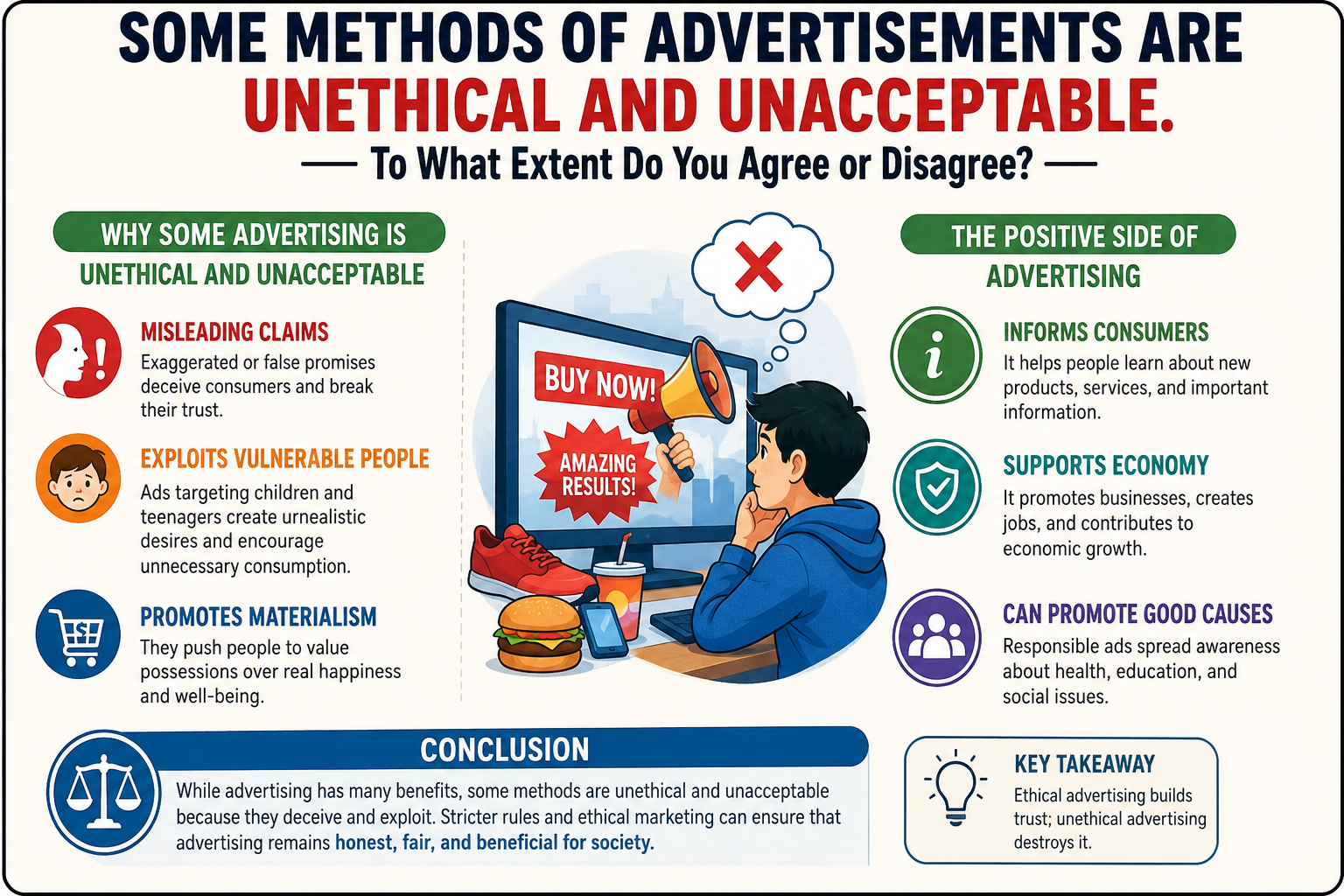
The primary reason for this view is that some advertisements deliberately mislead consumers by making exaggerated or even false claims. Companies often use deceptive marketing tactics, such as digitally altered images or unrealistic promises, to persuade people to purchase products that fail to deliver the advertised benefits. For instance, many cosmetic products claim to produce dramatic results within a few days, despite lacking scientific evidence. Such practices not only violate consumer trust but also encourage impulsive purchasing decisions, ultimately causing financial loss and disappointment.
Another compelling argument is that certain forms of advertising exploit vulnerable audiences, particularly children and teenagers. Young people are highly susceptible to persuasive messages and often struggle to distinguish between genuine information and marketing techniques. Advertisements promoting unhealthy foods, expensive gadgets, or online gaming frequently encourage unnecessary consumption by creating unrealistic desires and social pressure. As a consequence, children may develop poor eating habits, excessive materialism, or even addictive behaviours. This demonstrates why governments should introduce stringent regulations to protect those who are easily influenced.
Admittedly, not all advertising is unethical. In fact, responsible advertising plays a vital role in educating consumers about new products, health campaigns, educational opportunities, and public services. Honest advertisements enhance market competition, allow customers to make well-informed decisions, and contribute positively to economic development. Therefore, the problem lies not with advertising itself but with the misuse of persuasive techniques that prioritise profit over consumer welfare.
In conclusion, I firmly agree that some advertising methods are unethical and unacceptable because they deceive consumers and take advantage of vulnerable individuals. Governments should enforce stricter advertising standards, while companies should adopt more transparent and socially responsible marketing practices to ensure that commercial success does not come at the expense of public trust.
Band 9 Vocabulary (Highlighted)
- Indispensable – absolutely necessary
- Ethically questionable – morally doubtful
- Mislead – give false information
- Deceptive marketing tactics – dishonest promotional methods
- Impulsive purchasing decisions – buying without careful thought
- Exploit vulnerable audiences – take unfair advantage of easily influenced people
- Susceptible – easily affected or influenced
- Stringent regulations – strict laws or rules
- Responsible advertising – honest and ethical promotion
- Well-informed decisions – choices based on accurate information
- Consumer welfare – the well-being and interests of buyers
- Transparent – open and honest
- Socially responsible – acting in the best interests of society
- Materialism – excessive desire for possessions
- Commercial success – business achievement and profitability